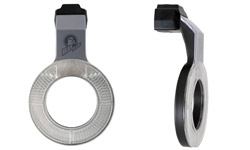
ExpoImaging recently dropped the price of its $300 Ray Flash to $200. It’s a pretty cool device if you haven’t seen it before (although I have yet to get my hands on one). Basically, it attaches to your on-camera flash and allows to you keep both hands on your camera and lens while you get the benefit of a lightweight ring flash. The Ray Flash is supposed to be pretty efficient with the light from your on-camera flash, so you don’t lose as much light as I do with my DIY Ring Flash.
David Hobby over at Strobist is pretty impressed with it, and so is Scott Kelby. Although, it’s gotten some mixed reviews among purchasers over at B&H Photo.
Check out the press release below for further details.
ExpoImaging Announces Price Change to Popular Ray Flash Ring Light Adapter
Direct Purchasing Relationship with Product Manufacturer Enables ExpoImaging to Lower Price of Lightweight, Portable Ray Flash to $199.95
WATSONVILLE, CA, January 8, 2009—ExpoImaging Inc., developer of innovative camera accessories, including the ExpoDisc Digital White Balance Filter and the ExpoAperture2 Depth-of-Field Guide, today announced it has lowered the price of the popular Ray Flash Adapter by $100 to $199.95, after entering into a direct purchasing relationship with the Czech Republic-based manufacturer of the product. The Ray Flash, which was launched in the U.S. in the spring of 2008, is a portable and lightweight adapter for shoe-mount flash units that replicates the unique lighting effect produced by heavy, tethered, powered studio ring flash units.
“The Ray Flash has been incredibly well received by the photography community, as it is easy to use and produces fantastic results,” said Erik Sowder, president of ExpoImaging. “We expect that the new price point will open the door for even more photographers to benefit from the product and enhance their out-of-studio photo shoots.”
Because ring light originates from a circle around the camera lens, the Ray Flash creates a distinctive lighting effect, producing a virtually shadowless look on the front of the subject, while leaving a soft, even shadow around the edges. The versatile adapter is ideally suited for fashion, wedding, portrait, journalist and macro photography, as either a main or fill-in light.
The Ray Flash, which easily slides over the front of a camera’s flash unit and locks into place, relies on a shoe-mount flash to generate its light. It does not contain electronics, batteries, flash tubes or cables.
Current models of the Ray Flash are designed to fit the Canon 580EX (MKI & MKII) and Nikon SB800 flash units, and the Ray Flash can also be adapted to fit other flash models. With a 4 1/8” internal diameter, the adapter is large enough to accept almost all professional lenses from both Canon and Nikon.
The Ray Flash is distributed exclusively by ExpoImaging, Inc. in the U.S. and is available through select photo dealers nationwide as well as online at www.expoimaging.net.
About ExpoImaging, Inc.
ExpoImaging Inc. develops and markets innovative camera accessories and is the pioneer in digital white balance filters. Ray Flash: The Ring Flash Adapter, ExpoAperture2 Depth-of-Field Guide and ExpoDisc Digital White Balance Filter are available at select photography dealers worldwide, or online at www.expoimaging.net.
###

