Canon’s Iris Registration Mode - Biological Copyright Metadata

Posted on February 9, 2008 by Eric


Canon is using Iris watermarking to take photographer’s copyright protection to the next level.

. . . to provide an imaging apparatus that makes it possible to protect the copyright of photographic images by reliably acquiring biological information of a photographer . . .  - US Patent Application No. 2008/0025574

Stories like the recent discovery of Rebekka Guðleifsdóttir’s stolen Flickr images that surfaced on iStockphoto make all photographers cringe.  Many photographers go to great lengths to protect their images.  Past attempted solutions include watermarks on the front of images.  I can recall this practice from my childhood years with the Olan Mills studio gold embossing in the bottom corner.

More recently, in the digital age of photography, watermarking in Photoshop or other image editing software.  While visible watermarks are common among a variety of photographers, invisible watermarks (”electronic or digital watermarks“), which are embedded in the image file,  are somewhat less prevalent - but gaining ground and acceptance among photographers.  Companies like Digimarc are pressing the digital watermark cause to protect photographer’s and other author’s data.

Camera companies are pushing forward as well.  Stories like that of Rebekka Guðleifsdóttir help increase the desirability and demand for practical copyright solutions in modern digital photography.

Canon’s Iris Registration Patent

A recent Canon patent application (Pub. No.: US 2008/0025574 A1) reveals the next step in digital watermarking - Iris Registration.

The short and sweet of it?

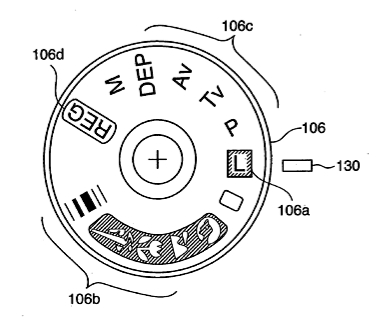
  1. Turn the Mode dial to “REG”
  2. Choose between “REG 1″ through “REG 5″ (for up to 5 registered users)
  3. Put eye to viewfinder
  4. Look at display of center distance measurement point
  5. Press the shutter button
  6. Iris image captured
  7. Go shoot

Additional embedded info can be added later.  All metadata will be added to images after you’re finished shooting in a collective manner and not for each image.  The purpose of the collective tagging, if you will, is to refrain from hampering the camera’s speed (frames per second) while shooting.

Admittedly, I have glossed over the claims of this patent.  You can take a look at some of the more specific terms of the patent in the quotes I’ve pulled from it below:

Summary

Another object of the present invention is to provide an imaging apparatus that makes it possible to protect the copyright of photographic images by reliably acquiring biological information of a photographer for the purpose of personal authentication and writing this photographer information to the image of a subject without affecting processing, and in a manner transparent to operation, at the time of photography.

According to the present invention, the foregoing object is attained by providing an imaging apparatus for taking an image of a subject by an image sensing device, comprising: registration means for allowing a photographer to register his/her own biological information in advance; storage means for storing the biological information; and personal-data recording means for recording the biological information in a photographic image.

Iris Registration Mode Setup

In the iris registration mode, a registration number is selected by turning the electronic dial 103. When the electronic dial 103 is turned clockwise, the registration number changes as follows in dependence upon the amount of rotation (number of clicks of the dial): “REG-1″.fwdarw.”REG-2″.fwdarw.”REG-3″.fwdarw.”REG-4″.fwdarw.”REG-5″. The registration number is useful when a number of photographers use the camera. The number is made to correspond to registered content in such a manner that each photographer can register his/her iris information. The iris information of the photographer is registered in association with the registration number selected. The registration number is displayed on the liquid crystal panel 104 for displaying photographic information and on the LCD 214 in the viewfinder. A photographer can store iris information for any desired one of five registration number. This registration number is displayed on the liquid crystal panel 104 for displaying photographic information and on the LCD 214 in the viewfinder. An example of display of registration number is as shown in FIG. 6. The illustrated example shows the manner in which the display transitions from REG-1 to REG-5 in accordance with rotation of the electronic dial 103. “REG-1″, “REG-2″, “REG-3″ are displayed in ordinary fashion, and REG-4, REG-5 are displayed in a flashing manner. This indicates that iris information has already been registered for REG-1 to REG-3, which are not flashing, and that nothing has been registered for “REG-4″, “REG-5″, which are flashing. A photographer can newly register iris information corresponding to a registration number that is flashing. However, if there is a registration number for which iris information has already been registered, this already registered iris information can be erased and new iris information stored in its place. If the electronic dial 103 is rotated one further click from the REG-5 indication, the display returns to “REG-1″. Registration numbers are displayed cyclically in accordance with rotation of the electronic dial 103 in this fashion. If the electronic dial 103 is rotated counter-clockwise, then the order in which the registration numbers are displayed is reversed.

Embedding Process

The photographic image (data) that has been recorded in the flash memory is written into the DRAM 511 temporarily, and the personal data that has also been read into the DRAM 511 is combined with or attached to the photographic image to thereby be written to the photographic image. After the personal data is written to the photographic image, a display indicating that removal of the memory card is permissible is presented on the liquid crystal panel 104 for display of photographic information, then the power supply is turned off following elapse of a fixed period of time (step S206).

More Embedding Details

As a result of the foregoing, biological information indicative of a photographer need not be acquired every time an image is taken and, hence, processing executed by the imaging apparatus is not subjected to a load in terms of the sequence of photography. Furthermore, biological information can be registered in advance. In a case where information inappropriate for personal authentication could only be acquired, therefore, it is possible to perform registration again. This makes it possible to acquire reliable biological information.

Further, registered biological information indicative of a photographer is recorded in a photographic image attendant upon an operation for turning off a power supply or removing a recording medium, or a command operation for transferring a photographic image to another image receiver, or an operation for reselecting other biological information from multiple items of biological information that have been registered. As a result, processing executed when an image is taken of a subject is not subjected to a load. In other words, congestion can be prevented by recording biological information at a timing at which an image is not being taken.

Further, by recording biological information as an image, coding means or an authentication unit necessary for personal authentication may be provided externally. This reduces the processing to be executed by the imaging apparatus.

Alternatively, by processing an acquired biological image into a personal authentication code and recording the code in the image of a subject, the amount of personal data serving as additional information may be reduced.

Alternatively, by embedding personal data which is biological information in the image of a subject as an electronic watermark, falsification can be prevented more robustly.

Alternatively, biological information may be processed into a personal authentication code and the code may be added on as an item of metadata. In a case where the image of a subject is handled by a third party, therefore, it is easier to deal with a photographer’s personal data as copyright information. At the same time, since it is unnecessary to apply processing to the image of a subject per se, there is no decline in image quality.

Further, many digital still cameras are equipped with a liquid crystal display panel in addition to a viewfinder. With a camera of this kind, the photographer can take an image while observing the display on the liquid crystal panel without looking into viewfinder. The camera of the illustrated embodiment is capable of combining personal information with captured digital image data even in a case where the camera takes images through this method.

Source -  Pub. No.: US 2008/0025574 A1


 Subscribe to Photography Bay

» Filed Under Canon, Technology


Comments

51 Responses to “Canon’s Iris Registration Mode - Biological Copyright Metadata”

  1. Canon to employ Biometric Digital Watermarking with Iris Registration - SlashGear on February 11th, 2008 5:54 pm

    [...] photographybay] thanks [...]

  2. Canon files patent application for eye-based biometric photo watermarking - Sparking Tech on February 12th, 2008 2:10 pm

    [...] Engadget, Photography Bay] Share: These icons link to social bookmarking sites where readers can share and discover new web [...]

  3. Canon’s eye-based biometric photo watermarking system hits the Patent Office. « The Photography Link on February 12th, 2008 8:16 pm

    [...] up, but you know photographers will be all over this when it finally hits. via Photography Bay, article. (opens in new [...]

  4. Canon’s eye-based biometric photo watermarking system hits the Patent Office | smartphonedownloads on February 13th, 2008 12:13 am

    [...] Photography Bay, thanks [...]

  5. Înregistrarea irisului – patent Canon « Resurse Foto on February 13th, 2008 2:30 am

    [...] Înregistrarea irisului – patent Canon Canon a înregistrat recent un patent care promite să ducă mijloacele de protecţie a copyright-ului fotografiilor la un alt nivel: înregistrarea amprentei digitale a irisului fotografului în fişierele foto rezultate. Mai multe detalii aici. [...]

  6. Landscape Photography and Nature Photography by Jim M. Goldstein - JMG-Galleries - The Future of Copyright Protection? Biological MetaData on February 13th, 2008 2:46 am

    [...] Photography Bay has dug up an interesting patent filed by Canon regarding “Iris Registration”. The patent titled “PICTURE TAKING APPARATUS AND METHOD OF CONTROLLING SAME” (Pub. No.: US 2008/0025574 A1) details a mechanism for a camera to capture an image of a photographers iris and embedding it in the pixel data of the images they take. “Another object of the present invention is to provide an imaging apparatus that makes it possible to protect the copyright of photographic images by reliably acquiring biological information of a photographer for the purpose of personal authentication and writing this photographer information to the image of a subject without affecting processing, and in a manner transparent to operation, at the time of photography. [...]

  7. Mayhem Ensues » Blog Archive » links for 2008-02-13 on February 13th, 2008 3:24 am

    [...] Canon’s Iris Registration Mode - Biological Copyright Metadata : Photography Bay Now that is hot stuff right there. (tags: copyright dslr photography tech cameras) [...]

  8. The needs of the Photographer » Blog Archive » watermarking pictures through photographer’s biological information on February 13th, 2008 3:40 am

    [...] [2] Canon Iris registration [...]

  9. PhotoGeek week #39 | photogeek.tv Podcast for the geek photographer professional prosumer or keen beginner on February 13th, 2008 9:18 am

    [...] patent an interesting technology, to provide an imaging apparatus that makes it possible to protect the copyright of photographic [...]

  10. Tsu Dho Nimh on February 13th, 2008 9:24 am

    Let’s say I steal the camera and take a lot of illegal pictures … child porn. And there are all those pictures, with someone else’s digital ID in them.

    Great forensics tool … or maybe not.

  11. US Patent Application No. 2008/0025574 - Canon application for patent for biological watermarking | j bryner photographics on February 13th, 2008 10:51 am

    [...] the entire article here at Photography [...]

  12. Marcas de agua con el iris de nuestro ojo « Living in pixels on February 13th, 2008 1:32 pm

    [...] Enlace - Visto en backfocus Véase también Solución para la info ISO de Nikon | Añadir la localización GPS a tus fotos [...]

  13. Canon Patents Iris Watermarking | PNW Photoblog on February 13th, 2008 2:59 pm

    [...] though has decided to patent technology that uses a person’s iris in the eye as the digital watermark. These are to embedded in the picture itself, probably on a hidden layer, [...]

  14. Jonny’s Play Lunch » Blog Archive » Play Lunch - Feb 14, 2008 on February 13th, 2008 7:19 pm

    [...] cards I’ve managed to squeeze in sometime to read an article (via Slashdot) about how Canon has filed for a patent on a technology that effectively embeds the iris information of the photographer into the data held [...]

  15. (Insert witty metadata-related blog title.) » Blog Archive » Biological metadata? on February 13th, 2008 8:12 pm
  16. A Biological Copyright | Gizmotastic.com on February 13th, 2008 10:35 pm

    [...] biological data, in this case from a human iris, to record the copyright owner of the photographs. Photographybay has a detailed run down of the patent that Canon has applied [...]

  17. Canon files patent on iris copyright « A day in the life of a Presson… on February 13th, 2008 11:43 pm

    [...] Posted by presson on February 13, 2008 Canon apparently has filed a patent that would grab an image of your iris when you take a photo, and adds it to the metadata for each image.  http://www.photographybay.com/2008/02/09/canon-iris-registration-watermark/ [...]

  18. The Graphic Staff News » Blog Archive » Canon’s Iris watermark registration on February 14th, 2008 7:29 am

    [...] This is really awesome technology. Canon is planning on implementing a way to copyright images by taking a scan of the photographer’s iris and digitally watermarking images with this information, possibly in the EXIF data. This will keep people from being able to steal images and sell them without the permission of the photographer. This technology won’t be beneficial for most point and shoot photographers, but I could see how it would definitely ease the minds of photography professionals who are wary of image theft. [...]

  19. r-ev.net | Noticias on February 14th, 2008 9:17 am

    [...] Iris image captured > Go shoot!! [...]

  20. 数码时代的版权利器:虹膜水印(Canon’s Iris Registration Watermark) on February 14th, 2008 11:07 am

    [...] [素材来源:1,2] [...]

  21. seeing & being seen » Blog Archive » Eye recognition on February 14th, 2008 12:08 pm

    [...] about your digital photographs being used by someone else? Canon has apparently just filed for an iris registration patent, whereby your images would be watermarked based on your very own photographic eye. Another object [...]

  22. Canon патентует защиту фото | ФотоДилер on February 14th, 2008 6:48 pm

    [...] Источник и дополнительные данные - http://www.photographybay.com [...]

  23. Audioscapist on February 14th, 2008 9:15 pm

    As we get closer to regularly using iris scans, etc. for security, wouldn’t this potentially be a boon for identity theft? Extracting that iris metadata from a digital photo will surely be figured out by hackers pretty quickly - and could then be used to gain access to other personal information. Anything that embeds personal information in a medium that can be so freely distributed as a jpeg image has as many cons as pros.

  24. News Cast Live, formerly Mike Thinks News » NewsCast LIVE #170 Matthew Ebel CD givaway…oh and News on February 14th, 2008 10:40 pm

    [...] Eye can tell thats my picture [...]

  25. Blog Foto-Time.NET » Archiwum bloga » Obraz siatkówki oka i nowy patent Canona on February 15th, 2008 2:52 am

    [...] PhotographyBay Dodaj nas do [...]

  26. the new shelton wet/dry on February 15th, 2008 5:33 am

    [...] Canon is using Iris watermarking to take photographer’s copyright protection to the next level. [...]

  27. Fred on February 15th, 2008 9:02 am

    I hacker or an expert thief could really make some good use of this new technology.

    for example:

    John works in this company, which he uses his eye scan to gain certain access.

    A hacker could follow him for many days, and one weekend day, while taking his kids to the park, the hacker comes to him and ask him to take a picture for him.

    in that process he could hack the camera to scan his iris and then later use it to gain access in the company he uses…

    haha

    sound kind of science fiction right?

    but u never know.

  28. Adding Biological Copyright Metadata to a Photograph | Scott Rouse Digital on February 15th, 2008 11:21 am

    [...] don’t quite understand fully how that helps, even after reading the full article available here, but it’s a story worth [...]

  29. pawel on February 16th, 2008 12:50 am

    That sounds very interesting… Eye-based biometric photo watermarking system. Realy great solution for paranoid photographers ;) I’d rather not want to store and spread my biometric data, why would i? I dont believe that anyone needs such ways to “protect” themselves. Storing this kind of info obviously has nothing to do with authenticating that image wasnt manipulated, and you could authenticate ownership by embeding something less private. Whats the next step? Our DNA encoded in open-id? :D In my opinion these kind of stuff somehow just makes us closer to Orwell’s Nineteen Eighty-four.
    cheers,
    pg
    http://www.stagephotos.net

  30. Saturday Links Fever [2008-02-16] at All Day I Dream About Photography on February 16th, 2008 5:08 pm

    [...] Canon’s Iris Registration Mode PhotographyBay Canon is testing the ground for a new biometric way for picture copyright, Iris recognition [...]

  31. Canon’s Iris Registration Mode - Biological Copyright Metadata « Across the Universe on February 17th, 2008 2:45 am

    [...] cource  подробности   Canon is using Iris watermarking to take photographer’s copyright protection to the next level.    [...]

  32. J a C k N e w s » Blog Archive » Canon listo para patentar copyright biológico on February 18th, 2008 6:44 am

    [...] <Noticia original> [...]

  33. PICTURAPixel - Bloco de Notas » Fotos roubadas e a invenção da Canon. A sua íris em cada fotografia. on February 18th, 2008 2:05 pm

    [...] notícia veio daqui. http://www.photographybay.com Na nota também há um link para a história de Rebekka. Como se vê, tudo está conectado e nada [...]

  34. batwing was here » Blog Archive » Lubię takie poniedziałki on February 18th, 2008 7:28 pm

    [...] Canon opatentował technologię,  polegającą na robienie zdjęcia siatkówki robiącego zdjęcie i umieszczania go w fotografii którą właśnie robił bez zniekształcania jej (vide steganogafia). Tak ciekawe jak i przerażające. [...]

  35. L’iris de l’œil comme signature at FrenchBuzzLand on February 20th, 2008 4:56 am

    [...] Pour garantir l’origine et le copyright des photos, le constructeur Canon lance la signature par l’iris de l’œil. Ce nouveau système permet, au moment où la photo est prise, de capturer l’iris de [...]

  36. Ирисово право | yovko in a nutshell on February 21st, 2008 4:03 am

    [...] съвсем се смахна. Очаквайте скоро цифрово подписани с ДНК-fingerprint [...]

  37. TSF - Indonesia Infosec Awareness Portal » Blog Archive » Canon Melindungi Hak Fotografer dengan Teknologi Biometrik on February 23rd, 2008 6:19 am

    [...] Banyak Baru-baru ini produsen kamera digital Canon mendaftarkan hak paten atas penemuan teknologi Iris Watermarking pada kamera digital. Teknologi tersebut memungkinkan seorang fotografer membuktikan secara otentik [...]

  38. Canon’s eye-based biometric photo watermarking system hits the Patent Office | The Tech Buyers Guide on February 23rd, 2008 2:22 pm

    [...] Photography Bay, thanks [...]

  39. Vseofoto.ru » Blog Archive » Сетчатка глаза как защита авторских прав фотографа on February 23rd, 2008 10:47 pm

    [...] Компания Canon получила патент на устройство, способное поставить защиту авторских прав на следующий уровень. Защита происходит посредством записи биологической информации фотографа, снятой с его сетчатки глаза, в файл изображения. Такие случаи, как нашумевшая история фотографа Rebekka Guðleifsdóttir, которая обнаружила на iStock свою фотографию, украденную из ее галереи размещенной на Flickr.com, заставляют всех фотографов обеспокоиться, а производителей фототехники разрабатывать новые методы защиты. Возможно, этот метод станет самым распространенным и надежным. Источник: http://www.photographybay.com [...]

  40. links for 2008-02-24 « The Ubiquitous Lens on February 24th, 2008 9:18 am

    [...] Canon’s Iris Registration Mode - Biological Copyright Metadata : Photography Bay As digital image copyright methods go… what a GREAT idea!! (tags: canon copyright dslr metadata photography security) [...]

  41. peruhoBlog » Blog Archive » Nueva patente de Canon / キャノンが虹彩を使う版権の特許を取りました。 on February 24th, 2008 11:29 pm

    [...] nada, sólo una nota tecnológica: Canon acaba de patentar el registro del copyright de una foto basada en el iris del autor de la misma. Muy curioso. En teoría, cuando hagamos la [...]

  42. Genial! Copyright Biométrico | Madsen Fotografia on February 25th, 2008 10:41 am

    [...] Mais informações > [...]

  43. Iris Integration System « Marc Edwards Photography on February 26th, 2008 7:22 pm

    [...] Photography Bay [...]

  44. Iris pattern watermark for images « scatterdrum on March 2nd, 2008 5:08 am

    [...] by Canon, possible use of the photographer’s individual Iris pattern, thanks to the PhotographyBay Blog for spotting this one, [...]

  45. Фотоблог » Blog Archive » Canon запатентовала свое средство защиты копирайта on March 19th, 2008 5:35 pm

    [...] Источник и дополнительные данные - http://www.photographybay.com [...]

  46. Tecnologie future: l’iride salverà il copyright? - www.reflex.it | Nikon Test on March 25th, 2008 10:47 am

    [...] i brevetti che i fabbricanti registrano a ritmo costante. Un brevetto Canon del 2007 recentemente rivelato riguarda la possibilità di identificare il fotografo che ha scattato le foto tramite la lettura [...]

  47. Verkossa » Leimaa digikuvat verkkokalvokuvalla on May 2nd, 2008 8:15 am

    [...] (via Photography Bay) [...]

  48. MXKY on June 4th, 2008 8:32 pm

    This is really an interesting post, I’ve learned many things, thanks for sharing! :)

  49. wickedass on June 27th, 2008 4:58 pm

    which particular canon model is this?

  50. Eric on June 27th, 2008 11:31 pm

    It’s just a patent. It hasn’t been released in a camera . . . yet.

  51. Scott Fillmer on June 28th, 2008 6:45 am

    That is just some incredible stuff… what you can add to meta data, unreal

Leave a Reply